It’s happening now through September 22 the Whitney Museum Biennial here in New York. For the past couple of days I’ve visited the museum and I am bringing a few thoughts on the show.
First of all, every time I have the opportunity to attend an event like this, I am very thankful to have such an easy access to the cultural diversity this city has to offer.
Without further ado, let’s first check the record of the biennial at the Whitney Museum. The show started in 1932 as an annual exhibit of the modern American art.
In the early sixties, the annual would alternate painting and sculpture as the focus of the show until 1973, when it finally became biennial but included all mediums.
The biggest problem, however, has always been lack of representation. Artists were mostly white male.
The Whitney Biennial was also stage of many controversies over the years. For instance, in 1987, the Guerrilla Girls protested the Biennial for racism and sexism. Even as recent as 2017, the paint “Open Casket”, by Dana Schultz sparked protests and a petition to get it removed because it depicted Emmet Till, a 14-year old African American boy who was lynched in Mississipi in 1955.
As mentioned above, the Biennial has a record of lack of inclusion. This year, however, of all 75 artists featured in the show, more than half are women, more than half are artists of color, and 3/4 of them are under 40. It is a great advance in arts and hopefully it will become a trend. Another good example will be seen in late October with the reopening of MOMA. What’s Up New York will be there to check it out.
Of course it won’t be possible to analyze every single piece on the exhibit so I decided to highlight some of the works that stood up to me:
The Procession
By the artist Nicole Eisenman, the installation is located on the terrace of the sixth floor. This piece is hard on the audience as it depicts eschatology views. It is somehow interactive and it will definitely have a space in my memory for a long time.

Incoming
The artist Keegan Monagham utilizes classical modern art techniques such as impressionism, expressionism and cubism. In this painting, the sense of perspective is challenged as the chair that holds the telephone is dwarfed. The use of bright colors gives the viewer a sense of dynamism to his paintings.

Maria-Maria
By far, my favorite piece of the show. The sculpture portraits an unconventional religious imagery. Porto Rican artist Daniel Lind-Ramos symbolizes both the Virgin Mary as well as the hurricane that battered Porto Rico in 2017. The materials used were sourced in the island such as the coconut placed as her head or the blue robes which were blue tarps used by FEMA (Federal Emergency Management Agency) to patch damaged buildings. It is a powerful image that expressed the resilience of Porto Ricans before the federal government negligence.

National Anthem
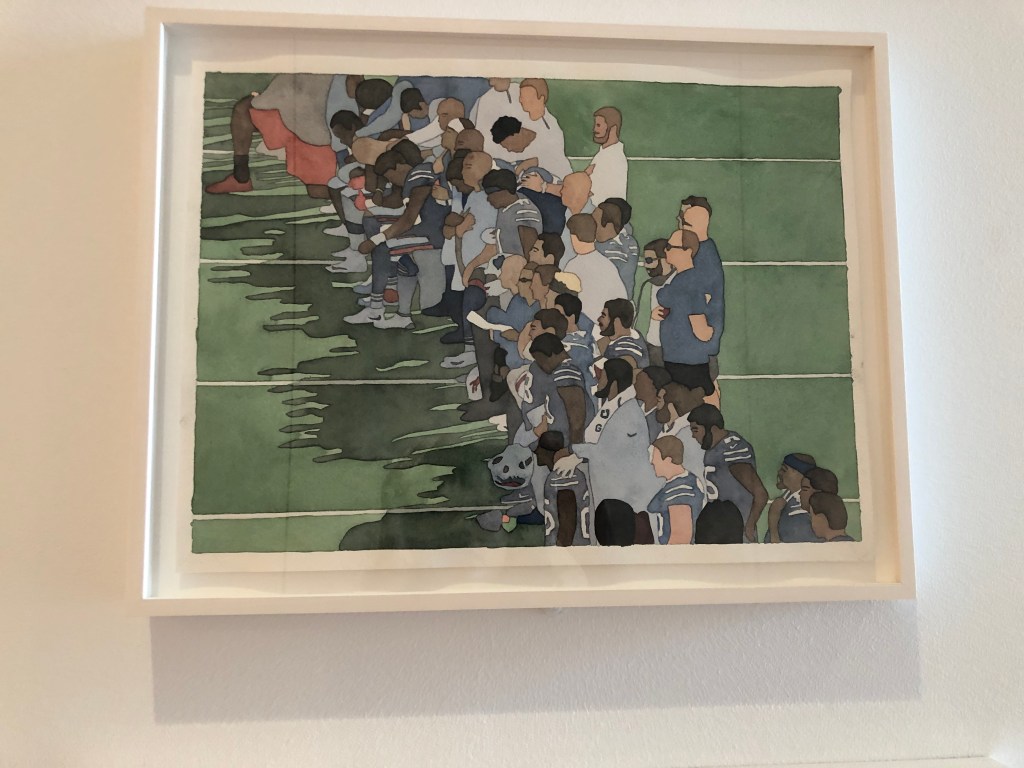
As soon as we step up the 5th floor of the Museum, we see this animation piece. It depicts the movement that started in 2016, in which NFL players take a knee during the National Anthem at the football games to protest police violence against African Americans across the country. In this work, artist Kota Ezawa is making a violence, race, and politics as the topic divides opinions amongst Americans.
Sentinels
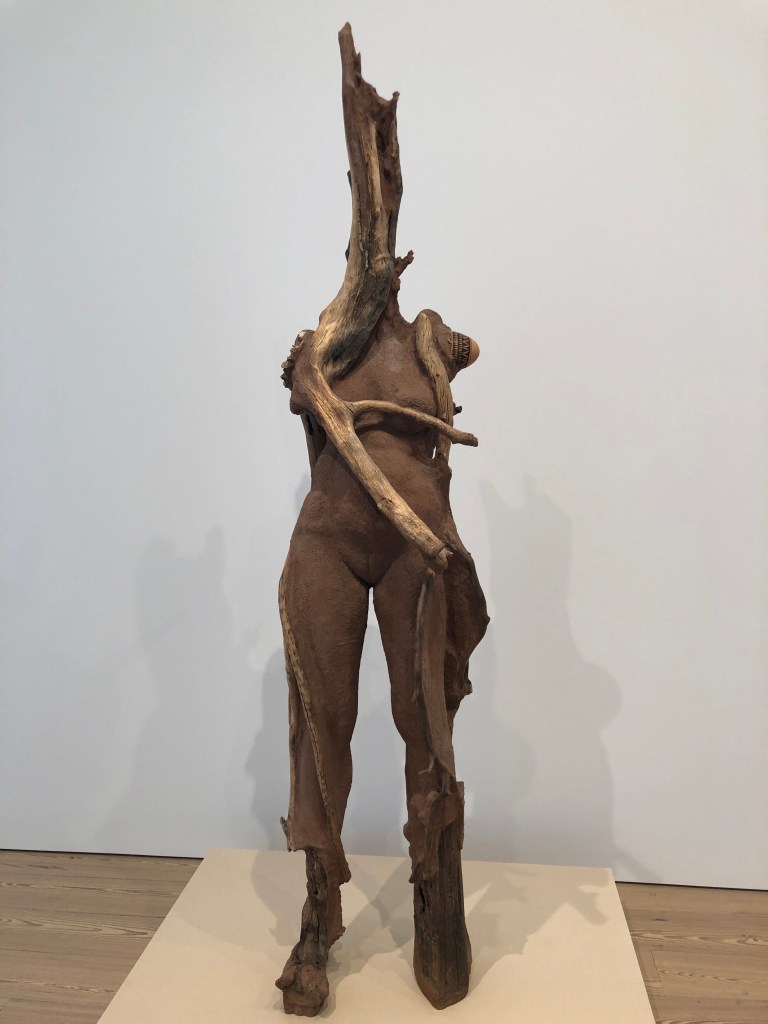
This set of sculptures represents a powerful portrait of women as well as its association with nature. It completely debunks the idea of fragile females. The piece also reveals its African identity. Nairobi artist Wangechi Mutu uses natural materials to represent an active connection with the earth.
Without being political, it’s impossible not to note the impact of a Trump presidency has in America and it’s reflected in many of the works of this show. For instance, artist Alexandra Bell revisits articles of the New York Daily News on the infamous case of the Central Park Five, in which 5 black teenage boys were falsely accused of raping a white woman in Central Park. One of the articles is an op-ed by Donald Trump calling for the death penalty. Another example is Marcus Fisher’s Words of Concern, in which artists reflect their fears concerning a Trump presidency at the inauguration day. It is an edited 3-minute tape record from a reel-to-reel recorder.
Besides of presenting the world with new tendencies of arts, the Whitney Biennial is also usually a space for controversy, as mentioned before. This time around, the museum was the center of a major issue as the vice chair of the Whitney, Warren B. Kanders, who is also connected to a company named Safariland, which manufactures tear gas. The tear gas produced by Safariland was reported used at the USA-Mexico border in November of 2018 against migrants trying to claim asylum in the USA. In protest 8 artists threatened to pull their works from the exhibit. Among them, Forensic Architecture, which denounces Safariland in a 10-min video entitled “Triple-Chaser,” in association with Praxis Filme, a film company owned by Laura Poitras (Citizenfour). Kanders eventually resigned from his position at the museum and no works were withdrawn from the show.
For more information on the show go to: https://whitney.org/exhibitions/2019-Biennial
 What's Up New York